Project Brief:
My Final Major Project is for me to use all the skills that I’ve developed over the past 2 years to produce an individual response that demonstrates this learning effectively. It is my own motivation, enthusiasm and determination that I put in that will produce work that I can be proud of. All my work pieces must be completed for assessment including my final pieces.
Within this brief I can explore any themes of my choice. Using a mind map on my chosen theme, I will identify areas to research. I will produce a project folder of idea development and my final piece(s). I will also describe and evaluate the effectiveness of my work throughout this project. I must demonstrate independent thought processes and working methods and have a degree of self-direction and motivation in planning, reviewing and organising my work.
The theme I choose can be interpreted emotionally, ambiguously, literally, abstractly, otherworldly, unnaturally, silly, seriously or any other way I wish to see it. The final outcome(s) can be my choice but must fully enable me to achieve the unit criteria attached and meet the requirements of this brief. I can create more than one final piece.
My Initial Thoughts about FMP:
Prior to starting this project, throughout all the units I have covered this past academic year, I have tried to think about FMP. I’ve tried to keep this thought in the back of my mind so when the time did come round to start FMP I would’ve had some knowledge as to what I wanted to create, however, this isn’t the case. To begin, I am very unsure on which route I want to take for this unit, there are so many pathways that could lead me onto creating such vastly different outcomes, it’s hard to comprehend. Despite the fact that I am unsure on what I want to create, I am sure that I want to focus on a topic which I am passionate about and intrigued by. This way I know I can produce work to the best of my ability because when I’m interested in a subject I work because I enjoy it, opposed to because I have to. This therefore creates a huge difference in my final outcomes, as I will be proud of what I make, and I wont be making it for the sake of it. So I do have certain goals in place which I am positive I will reach (finding a topic that I enjoy).
Analysing the Brief:
When reading over the brief it initially read to be very complicated, there’s a lot of listed criteria which could be depicted as being quite overwhelming. As I work confidently and systematically, I didn’t allow myself to get confused by the brief, instead I analysed it- broke it down- so it was easier for me to understand.
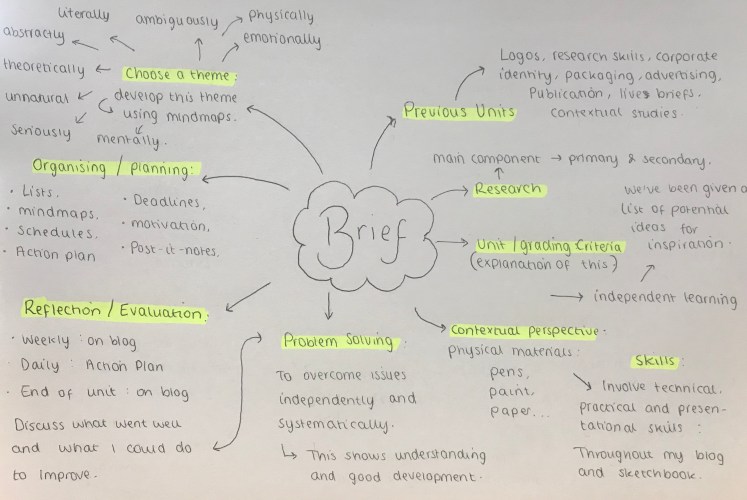
When analysing the brief I came across my ‘unit criteria’ this is what I need to work against to ensure I complete this unit effectively, I thought it was smart for me to analyse this too, therefore I will have a full understanding of what I need to complete. I printed this criteria off and I highlighted key words to help me remember to stick by these throughout this project:

Criteria Exploration:
To explore the criteria even further, I am going to analyse some of these key points or words within the unit criteria that I may not understand, this way it will lead me to knowing exactly what I need to accomplish to earn a grade I can be happy with:
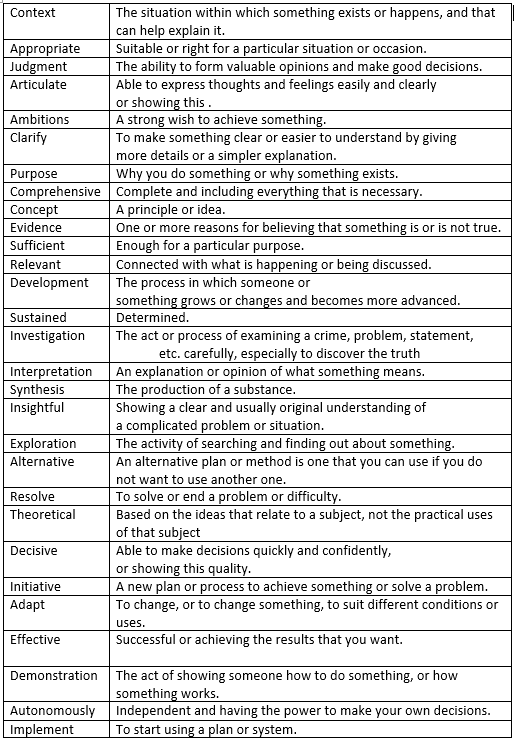
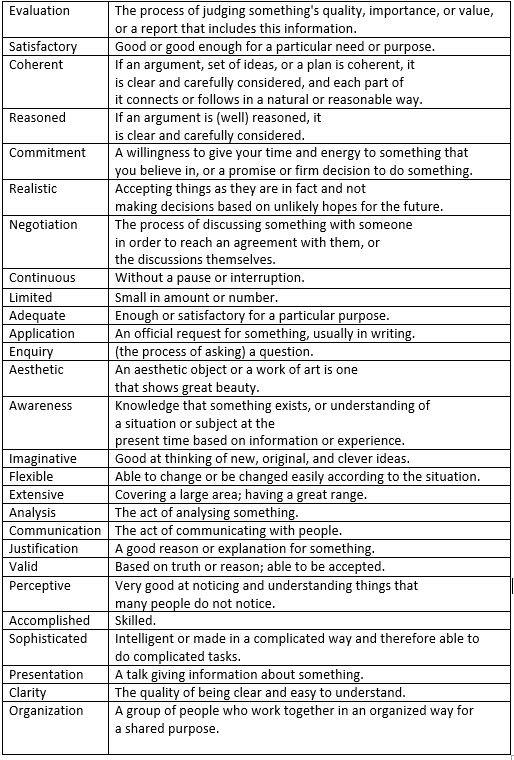
Now, due to my mind-maps and analysis, I believe that I have a full understanding of what the brief is demonstrating. Now I feel confident enough to move onto thinking about initial ideas for what I could create for this unit.
Initial Ideas for FMP:
In contrary to my initial thoughts, where I discussed how felt about this project, my initial ideas is what first springs to mind when I think about what I want to create for this project. I decided to create a mind-map to demonstrate my ideas as they allow me to break down ideas as they flow into others:

These are just rough ideas though, it’s helpful for me to write these down because then when my ideas develop i’ll be able to look back to this mind map and see how my ideas have adapted. This shows progression. Despite this mind-map, I still don’t believe that I’ve explored all potentials areas that I could go into for this unit. To help this situation I am going to create another mind-map on different themes I find interesting.
Week One Evaluation – 03.02.20 – 07.02.20:
As this week was the first week of this project, it was mainly me reading over the brief, trying to understand what it is we need to create for this project, and to comprehend the criteria, so I could follow it to achieve the best grade possible. To help my understanding, I created several mind-maps, and I broke down key words to further my knowledge upon what the words mean. As it’s the first week, my main goal was to start looking at initial ideas for this project, exploring potential themes, again I done this through mind-maps. I am pleased with where I am so far, as I have started on time, I also do not have any other ongoing projects that I need to finish, therefore I can put all my time and effort into this one project, which will boost me a lot as I will not get stressed thinking about multiple deadlines. Next week I am going to continue creating ideas for potential themes, my goal is to have a chosen theme by the end of this upcoming week.
(continuation from before week one evaluation)..
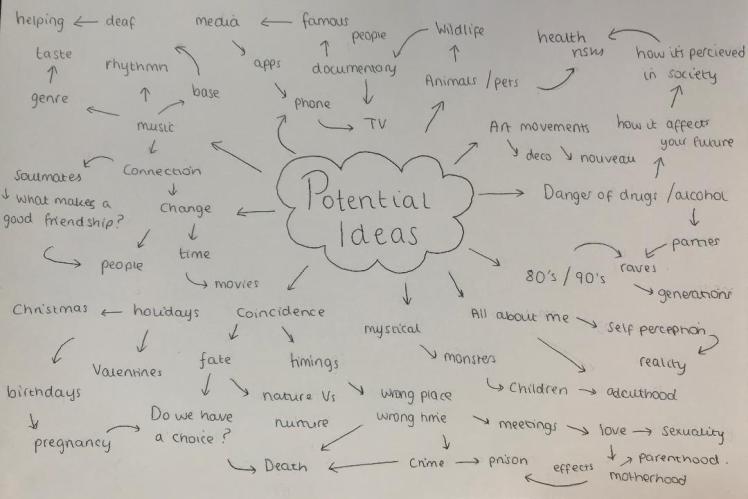
I have now got another mind-map of potential ideas for my theme. There are so many different routes I could take for this project, at this current point I am not sure upon which pathway I am going to take, so to help me develop I am just going to research aspects that I enjoy, because this may lead me onto finding other potential ideas that I could take further. From my mind-maps, some ideas that I do find interesting would be coincidences and fate, so I am going to correlate these under the topic of mystery, then research this further.
Theme Exploration – Mystery:
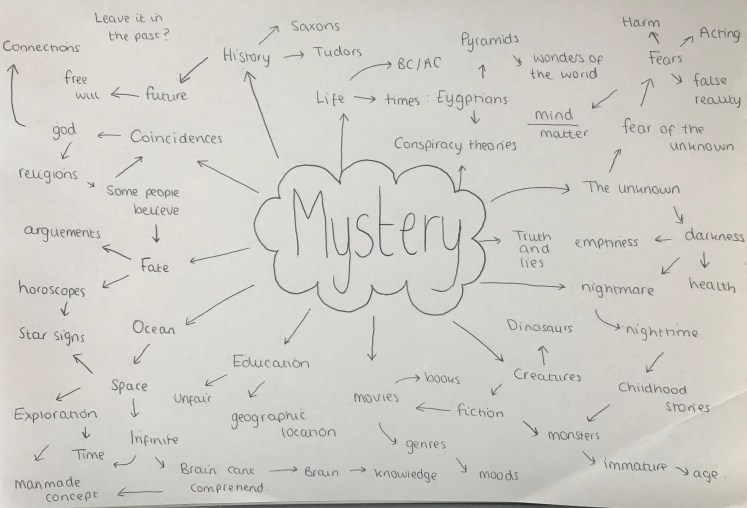
So by researching mystery further I have realised that I enjoy talking about and researching aspects like fate, star signs, healing processes, aroma therapy etc.. Although I didn’t discuss these elements within my mind-map, creating this mind-map allowed to think of these ideas, it pushed my thinking down that route. Now I believe I have a sturdy theme that I can go into and develop, although I don’t know my concept or what I’m going to create yet, I’m pleased that I now have a broad theme. I will now go onto developing this theme further.
Theme Development:
All of the elements that I find interesting I would state that they all fall under the semantic field of spiritualism. I don’t want this research aspect to get confused with my real theme research that I will be producing later in this project. In this section I want to find routes that I could potentially research, and vaguely describe what spiritualism actually is. I will collate research using mood-boards and lists.
What falls under Spiritualism?
According to the dictionary, the definition of spiritualism is: “a system of belief or religious practice based on supposed communication with the spirits of the dead, especially through mediums”. – This is not what I initially intended my theme to be, I wanted to focus more on well-being, the mind, body and soul, not so much death and the afterlife. I do not want to go down the routes of religions as this is a very controversial topic to talk about, I am also more passionate about how we can improve our current life, and not what happens after.
Therefore I am glad I researched into the actual definition of spiritualism as I was wrong about what it actually meant. I now need to find a new concept that involves all of the previous aspects that I found interesting, without going into the pathway of actual spirits. To do this, I have a friend that is very knowledgable regarding this subject, I am going to ask him for help to see if, together, we can come up with a new theme that is more relevant to what I want to create. We will have a discussion about my potential ideas and see if we can come up with a theme.
-After discussion- we came up with the idea of holistic health.
What falls under Holistic Health?
Similar to before, I will include the official definition to help people understand. This definition was taken from an online dictionary: “Holistic Health is actually an approach to life. Rather than focusing on illness or specific parts of the body, this ancient approach to health considers the whole person and how he or she interacts with his or her environment. It emphasises the connection of mind, body and spirit”.
From this definition you can see how it corresponds to my interests more specifically, it doesn’t involve death, instead it focuses more on our well-being and our environment. When discussing ‘my interests’ I am talking about different aspects that I want to learn about more, and that I find fascinating. I want this project to help my day-to-day life, so by researching something I’m passionate about, I won’t see it as work, but as enjoyment. These interests are:
I decided to display my ideas through a word cloud, I thought this was a pretty way to demonstrate my interests, also making it interesting for my audience. I used colours that I thought reflected calmness and tranquility. I did start to produce my interests on an online mind-map: However, as I was creating this I didn’t like the aesthetic of it, hence why I went through with the word cloud instead. Now I have demonstrated my interests (some) for what I want to research within this project, I will be able to look back at this word cloud later and research each of these interests further. I don’t want to research too much about this topic, as I previously stated, I just wanted to demonstrate what I am going to research when that portion of this project comes. Now this is achieved and I have a theme in mind, I can move onto the next part of this project, which is analysing feedback from my previous units.
Previous Unit Feedback:
I’ve decided to analyse all my feedback from my previous units, this way I know my areas of strength and weakness, therefore I’ll know where I have to improve upon to gain the best grade possible.
To begin with I screen-shotted each of my unit feedback pages, I then proceeded to highlight key points; red for my improvements, and green for my strengths. I didn’t highlight all of them, I just chose the ones that I thought were most important. I then screen-shotted these again, which I will upload. I chose this method of highlighting the points as it’s easy to see where I can improve and what my successes are, with just a quick glance- as the specific colours make it easier to see.
Slideshow:
Along side this slideshow, I am going to summarise my strengths and weaknesses, in a clear, easy to understand table, I already noted these down in bullet points (I will insert a picture of this below) so I will just use my notes from this for the table. Afterwards I can then move onto the next portion of this unit.
Notes:
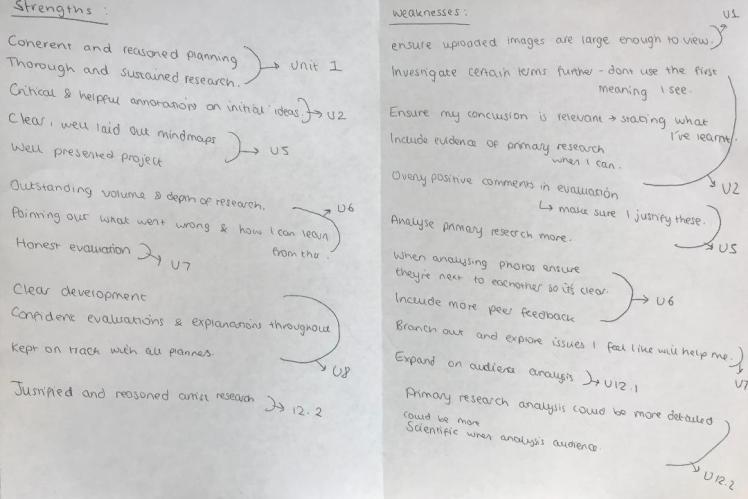
Table:

Week Two Evaluation – 10.02.20 – 14.02.20:
My goal for last week was to have a chosen theme by the end of this week, I believe I have achieved this as all my mind-maps narrowed down my themes to my preferred theme of holistic health. By briefly researching my theme it demonstrates what I am going to research in depth later, it also helps the audience understand as they may not know what certain words or phrases mean. I involved different ways of presenting my work including word clouds and online mind-maps, even though I wasn’t pleased with the outcome of the online mind-map I still decided to include it to show my different processes.
This week I also analysed my feedback from previous units, by understanding and knowing my areas of weakness this will help me to rectify these and help me develop to become more confident and to generally improve the quality of my work. This upcoming week I want to start researching about my pitch, by the end of the week I want to know what I need to include within my pitch, but I may not have began making my pitch at this point. To achieve this goal I will break down the pitch, similar to how I broke down the brief, analysing parts I do not understand.
My Pitch (Research):
For this project we need to include a pitch, this is where we promote our ideas to other people, pitches are usually used to market ideas to clients, customers or investors, however, in this case, we will be pitching to our classmates and teachers- to demonstrate our potential ideas for our final pieces. The pitch is a very important part of this project, as it’s what sparks your ideas, demonstrating your style and creativity to others. The benefits of having a strong pitch alludes that you are confident within yourself and your potential, showing your understanding for what you need to create and the steps you need to take to get there. A good pitch also needs to be engaging, you want the people you’re pitching to to think about what you’re saying, to question their normal perception, push boundaries about their understanding, leave them questioning your ideas. This way you know you have made an impact on them, therefore you have created a successful pitch.
On the other hand, a pitch doesn’t just help your audiences’ understanding, but it also helps yourself. By me creating a pitch it’s going to help me break down different ideas, analysing themes as I will create different mind-maps and mood-boards to demonstrate my thought processes. Hopefully by promoting my ideas it will help to push me in a certain direction, so I will be closer to choosing a final theme which I can then develop; by researching it further. After my pitch I should have an inkling of the path I want to take. When I create my pitch I will gain feedback afterwards, I will be able to see other peoples opinions and perspectives, and by listening to perspectives it will help to develop my own perspective; which can only aid my knowledge. So now I have explained and understood what a pitch is and the purpose of a pitch, I will research what I need to include within it.
What to include within my pitch:
I need to remember that the ideas I discuss throughout my pitch are not final ideas, they’re purely ideas on routes that I may take. I decided to create a mind-map on key points that I need to remember when creating and presenting my pitch. I can quickly glance at this mind-map just before presenting my pitch and the highlighted points will help me remember what to do.
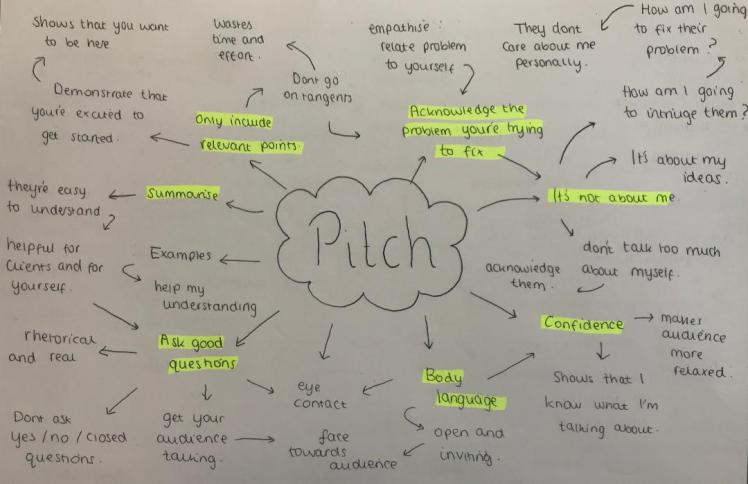
There are several topics that I want to touch upon when creating my pitch. I decided to discuss and analyse each of them; this way it helps me stay focused as it gives me a path to follow:
My Aims: In my pitch I should discuss my aims, this is what I want to achieve at the end of this project, not what I want to create. Do I want to develop skills in photoshop? Do I want to include questionnaires? I should be quite broad, as it’s only things that I would like to achieve. I could also confer about how to stay organised throughout this project (aims for schedules and plans).
Synopsis: Different to my aims, where it’s more personal about what I want to achieve, my synopsis is discussing which areas I might touch upon within the project, I shouldn’t go into too much detail here, as it’s quite early on in my pitch I need to keep it interesting for my audience. I can discuss the steps I have already taken to make the brief clearer (present brief mind-maps and previous research) on this slide.
Potential Themes: A few slides demonstrating my initial idea mind-maps, discussing potential ideas and narrowing it down to themes that I find interesting, this way I can show how I’ve explored multiple themes and then picked out the best ideas and developed them further, showing progression, which is a key element in this unit.
What I might do: By this I mean which different elements I could include within my research, what investigations I may carry out, how I will use physical mediums like sketchbooks to aid my process, discussing digital medias I may explore (being quite vague- not saying for definite what I will use (as I don’t know for certain at this point)).
Potential Target Audience: Again, this should be quite vague as I shouldn’t know what project I want to create at this point. However, from my further theme research, I may know what age range I’d like to focus on, or have a slight knowing of who/what ages would be interested in the same topics as myself. I can talk about what age ranges there are, and what demographics are the most common to influence. Remember primary, secondary and niche market (potentially different slides of pitch).
Health and Safety Risks: This should always be an important factor when creating a project. You need to ensure you’re not putting others, or yourself, in any sort of danger, so I will just touch upon different risks there may be in my working environment. I could also talk about health as in mental health, and how to keep my mental well-being strong.
Plans/Schedules: Within my pitch I can demonstrate my different plans for staying on track: including my action plan and research log. I will also create a basic predicted plan for the entirety of the project, this way it gives me insight for where I should be when the project develops (however, this plan may change as it’s very early stages).
What to do Next: It’s always important to know what your next steps are, this way you’re not going to get lost or go on any tangents, you have a plan to follow and it keeps you on task. I will not go in depth about what I’m going to do next here, as I will go in depth within my pitch. I should confer about my project proposal, as that is the next step after my pitch.
My Pitch Theme:
As I was looking through different templates and themes on powerpoint I came to the conclusion that there aren’t really any designs which I like or are in my style:

Therefore I am going to create my own theme for my pitch, this way I can specifically tailor it to myself and my own aesthetic.
I want to keep it quite minimal as what I’m talking about within my pitch is more important then the design of the pitch, so I don’t want to distract my audience away from what I’m discussing, however, as we’re getting assessed on our presentation, I do want to make it aesthetically pleasing. So I think I am going to choose a subtle, delicate background to use throughout, then involve images of my mind-maps and mood-boards to add more detail.
–
As time went on I decided to look back at the different options on powerpoint and I did actually find one that I like. It’s called ‘crop’, and I then just changed the colour of the text and background to my liking. Now I can actually proceed and start creating my pitch.
Week Three Evaluation – 17.02.20 – 21.02.20:
My goal for this week was to understand what I need to include within my pitch, I have achieved this goal. I feel as if I have made good progress throughout this week, due to my time management skills. We only have college 3 days a week, but I do work throughout the whole week purely because I hate feeling rushed or pressured, I work better in my own time where I can concentrate and get my work up to a standard of which I am happy with, so working throughout the whole week allows me to do this. This week involved a lot of planning, similar to my first week when analysing the brief, this time I analysed the pitch, therefore I know what I need to create in the upcoming weeks. At the moment I don’t have any worries or concerns, so far I feel positive with the place that I am in. As the past three weeks have been mainly breaking down different aspects and planning, I’m excited to start producing my pitch as I move onto the developing/working stage. I will continue to create my pitch next week.
Previous Pitch Feedback:
As we get marked on our presentation of this years pitch. I thought it would be beneficial for me to look back at last years pitch feedback, this way I can execute the things that I needed to improve upon. This will enhance my pitch overall, as I would’ve learnt and grown as a presenter.
I screen-shotted a paragraph I wrote from last years feedback analysis:

So when presenting my pitch I need to talk slowly, and explain my imported photos. I am now confident going into presenting my pitch, as I know what I need to do to make it enjoyable for my audience.
Week Four Evaluation – 24.02.20 – 28.02.20:
This week was me focusing on actually creating my pitch, duet my good planning skills last week, I knew exactly what I had to do to produce my pitch, I just followed through the steps that I had created for myself. Working through my pitch was quite straightforward, however there were a few times that I felt a little bit frustrated as I didn’t believe what I was doing was necessary. For example, in my predicted plan for the whole unit, I know I’m not going to stick to this plan as it’s too early to judge, however, I still produced one despite me not wanting to. I know that in the end I’ll be able to compare what actually happened to what I had planned. Next week I will go onto actually presenting my pitch, therefore I need to rehearse what I’m going to talk about- ensuring I hit all of the key points to maximise my audiences pleasure whilst listening to what I’m saying. By the end of next week I would have wanted to have imported my pitch onto my blog (powerpoint and video) and analyse the feedback which I’m going to get. However, I’m pleased that my pitch is completed.
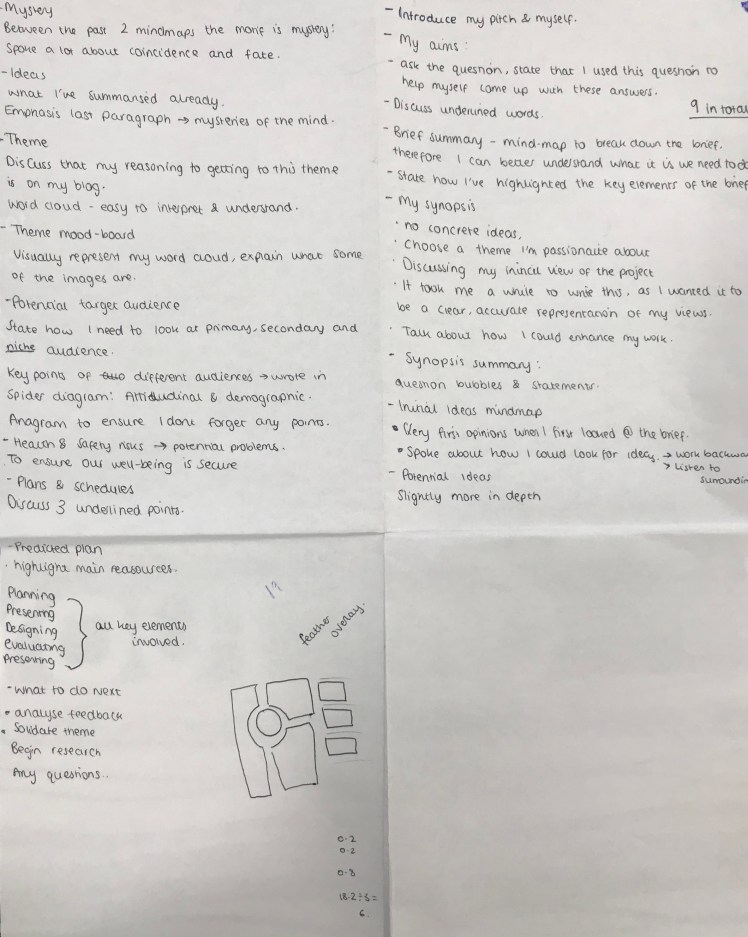
To help me prepare for my pitch I decided to go through it and write out the most important parts that were on each slide, therefore they’re in the forefront of my mind. So when I go to present my pitch, I know that I’m talking about important, relevant points:
My Pitch:
Powerpoint:


Video:
Below is an uploaded video of my pitch. The video quality isn’t the best as it’s difficult to actually see the board due to the high contrast, however, it still demonstrates my presentation skills.
Pitch Feedback:
Before Presentation:
Before I actually presented my pitch, I asked for feedback upon it, this way I could make any adjustments before I present it. Overall the feedback was positive, but my teacher said I could make a few amendments in regards to the theme mood-board. After, discussion I agreed to change the layout of it, the opinions were that it was quite messy, and that I should make it more uniform as symmetry is more visually appealing. So I listened and changed the layout of my mood-board:
Before:
After:
I was then happy to present my pitch.
Peer Reflection:
Slideshow:
So the slideshow above is all the feedback that I got from my pitch. To clearly represent my strengths and weakness, I have produced a table. I took points from each piece of feedback, and included these within the table:

This way I can understand which areas I need more work in, and I will be able to implement these into the rest of my project.
Self Reflection:
I have a tendency of over-thinking certain situations and I work myself up when I don’t need to, so before I presented my pitch I got very nervous. This led me to forgetting key points as I felt like I was rushing as I was talking very fast due to my nerves. I knew what I was talking about so I should’ve just took a minute to breathe and recognise the situation I was in, therefore I could’ve controlled the situation and calmed myself down in order to perform better. Nonetheless, I’m still pleased with my pitch as I did talk about each slide and I feel like I discussed specific elements that my audience might got confused about.
Even though I analysed my feedback from last years pitch, I still made the same mistake, which was talking too fast, however I feel as if this is a natural human reaction when presenting so I’m not too concerned about that error, as nerves show that you care. So overall I am pleased that my pitch is now presented and I feel as if I generally got positive feedback. I can now move on from my pitch, and create my project proposal.
Project Proposal:


Week Five Evaluation – 02.03.20 – 06.03.20:
This week I presented my pitch, and I then gathered feedback which I then analysed. I feel as if it’s important to establish your strengths and weaknesses this way you know what you need to do to improve (further pitch feedback analysis can be found above). Not only did I get my peers to reflect upon my pitch, but I also produced a self reflection, personally explaining how I thought my pitch went. I also created my project proposal this week. I feel like I got a lot accomplished this week; I’m proud of how I managed my time- my plans and schedules really helped with this. I have chosen holistic health as my final theme, creating my pitch and producing the mind-maps really helped me to come to this conclusion. I’m excited to start researching this topic further. In regards to my predicted plan I am a week ahead, I feel like this is due to my time management skills and how efficiently I work, in my predicted plan I was meant to start my project proposal next week, instead I’ve completed it already. So I’m pleased that I’m in a good position in regards to my plan, this gives me a longer amount of time to complete my research and development.
Research:
One of my main goals for this project is to help benefit peoples way of life, I can do this by changing their perception of what’s involved within being ‘healthy’, so hopefully they can change their routines to better their lifestyle. To begin with I will subjectively talk about what the term holistic health is, then break it down into all its different components involving: balance, biochemical, physical, psychological, and total health, this is to enhance my audiences understanding.
Firstly, holistic health is all about finding your balance, this is a state of your body being in equilibrium. When you become unbalanced that’s when things begin to go downhill, a numb, automated version of yourself is portrayed, not your true self. Remember as a child, you would jump out of bed in the morning because you couldn’t wait to start your day? Where did that feeling go? Holistic health covers all the topics that help you get your spring back. Hopefully, as I spread more into this topic, I will touch upon aspects that you can relate to yourself, to help you find your balance.
Holistic health is healing the mind, body and soul, using natural remedies and practices, in order to target the source of poor health, opposed to just helping the symptoms of poor health.
Introduction to Health
To begin with, I want to explain what health really means. So many people have a perception on what they think being healthy is, and that isn’t necessarily correct. So you have a salad for lunch, that makes you healthy right? You went to the gym for the first time in 2 months, now you’re healthy again. You didn’t drink any alcohol this weekend, so you’re feeling good. All these examples are not accurate representations of being healthy. Becoming healthy comes from so many different aspects, it takes time to become healthy, it takes dedication and strong will power. The first step to being healthy is to listen to your body, it tells you everything you need to know, if something doesn’t feel right, don’t do it, its intuition. Linking back to caveman times when they would rely on instinct, nothings change, trust the vibes and feelings you get about your body. I will discuss vibes further, later in my research.
Going back to balance, you can normally sense when you’re out of balance. A simple way to check if your in balance is to ask yourself, am I happy? If the answers either: ‘I don’t know’ or ‘no’, then you’re not balanced. This is where different aspects of holistic health come into play, these aspects aid your health, to push the answer to ‘yes’. Vaguely, balance is: ensuring you take time for yourself, whilst also enjoying the company of friends and family, having a career/job but not letting it over-rule your life, but also simple things like: sleeping well, eating well, sharing problems, indulging in new experiences, being active etc.. These all play an important role in maintaining your personal balance/energy, I believe when your energy, in the context of your vibration, your aura, is at its prime, this is when you’re on the right path to achieving optimum happiness. I will touch upon your vibration and aura more in-depth later in my research.
On your path to achieving overall health, you need to evaluate your life- in depth. There are probably many different parts of your life that you could pin-point that drag down your energy, for example: smoking, drinking, late nights. I’m not suggesting that having a late night makes your energy lower, but a late night every night definitely negatively impacts your health, remember, balance. Balance these late nights with early nights, this is one step you could take to achieving a healthy lifestyle.
– I wanted to give you some of my own opinions upon health before I research it in a lot more depth. I hope I’ve already stemmed new thoughts in my readers mind. I’m dedicating this unit to helping others, so by including my own knowledge and thoughts upon the subject, I think this gives a better insight into me and my values for this project. So now I’ve briefly introduced health, I think it’s important for me to break it down and analyse it in depth- not basing it of my opinion.
Health:
The Health Triangle:

So these are the three main components that build up health, they all play a vital role, by working both individually and together in harmony. In order to build up a definition of your own health, you will need to evaluate each section of the triangle, this will allow you to establish your areas of weakness, and how you can alter this to make positive changes to your health. By recognising your weaknesses you will be able to put goals into place, ensure to prioritise your goals as prioritising is an essential part in finding your balance. If you only focus on one corner of the triangle, say you’re only focusing on your career, the other corners are going to become unbalanced. Unhappiness impacts our psychological health, which in turn affects our physical health, which then affects our biochemical health, everything is linked when it comes to total health. It’s vital that you stand back and evaluate yourself. Ask yourself, if I were to die tomorrow, have I spent my time well? Remember it’s never too late to change, it’s never too late to achieve total health.
– I want to help people recognise where the gap are in their total health, and help to close them so then they can live a happier life.
Biochemical Health:
Biochemical health focuses on the literal chemical and biological processes that occur within our bodies. It covers what chemical reactions occur within your body when you eat or drink certain foods or drinks, what happens to your body when you breathe in clean air, opposed to polluted air, and more. Biochemical health also correlates to your diet, nutrition and digestion. This corner can be quite difficult for people to grasp, as we do not usually conceptualise the particles in the air we breathe, or take into consideration what we put our bodies through on a day-to-day basis.
-My main goal whilst talking about biochemical health is to educate my readers on the importance of recognising the processes that occur within our body, and what we could do to help build our energy for this corner of the triangle, in order to achieve balance.
Healthy Eating:
When trying to understand if you are biochemically healthy, you need to analyse what you eat and drink, and in order to successfully evaluate yourself you need to be aware of what healthy eating involves. It’s important to learn about the different food groups, this way you’re educated on what you should and shouldn’t be eating, and how much of each foods you should be consuming. Every persons biochemistry is different, what works for one person may not work for another, especially when it comes to nutrition and diet. Many people follow strict rules of what we should include within our diet, without analysing themselves, their bodies, as previously stated, it’s so important to listen to your body and understand what you do and do not need.
– I remember one time a few years ago, I was very conscious of what I was eating, I thought I was too unhealthy so I completely cut out sugar from my diet, I stopped eating: cake, cookies, sweets, chocolate, and drinking fizzy drinks all over night, instead I would either replace this with fruit, which is good, or nothing at all. As the days went on I thought I would be feeling full of energy and life, instead I was quite the opposite. My blood-sugar levels dropped very low, as you would expect, and I became very weak and tired, feeling shaky and constantly on edge. This is not being healthy. I needed sugar, and this is where I should’ve listened to my body, and ate something sugary. This is just an example of what could happen if you don’t eat foods in balance. Going forward I continued to eat more fruits, and instead of cutting out every form of sugar, I cut down and then cut out some of the foods I mentioned. Making huge drastic changes overnight are not typically healthy either, although this method may work for some people, for the majority you need to change your diet in stages. This gives your body time to adapt to these new or restricted amounts of food.
So going back to your biochemistry, looking at foods, many of us do not realise how contaminated our food is, contaminated with pesticides, hormones to aid growth, toxic herbicides, and many other chemicals used to try to get the highest amount of yield possible. So much of foods nutritional value will deplete and be lost when these strong chemicals are used, and this all occurs before our food is chemically cleaned, processed and packaged. These modern intensive farming methods strip these foods of their purpose, now they’re just substances to ‘fill a hole’ opposed to products that are meant to aid our health.
There are many arguments against organic and non-organic foods. Many people didn’t see any difference, and they didn’t care where their food was from. That used to be me, my opinions are changing though the more I research this topic. As I learn more about nutritional health I feel as if where our food comes from does play a very important factor within our biochemical health. The more foods we eat with high nutritional value, the more it’s going to raise our energy, our vibration, which leads to benefits in this corner of our health.
At some point during our life, normally in lower school, we would have been shown the ‘Eat-Well Plate’:
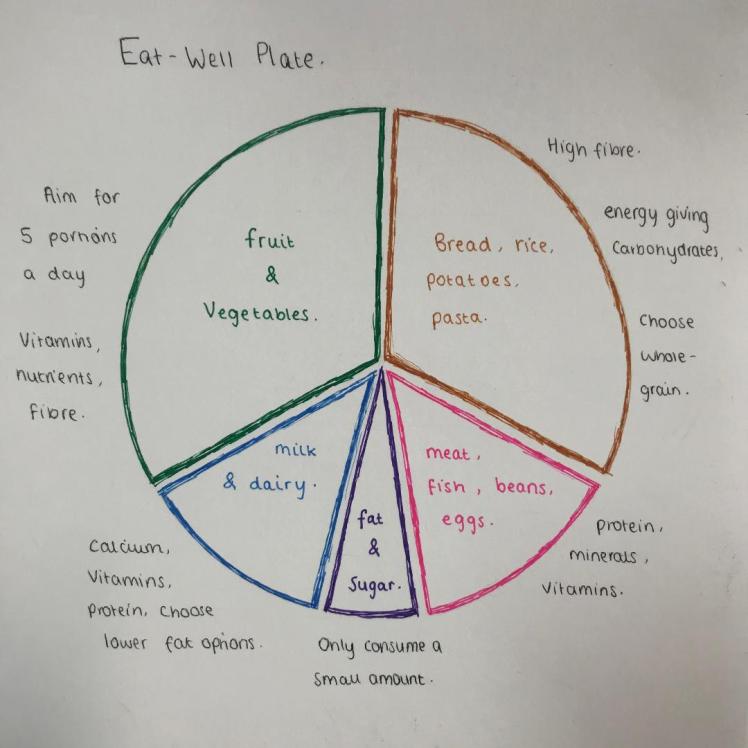
Although this is accurate to some extent, again, these are just guidelines. For example: a bodybuilder is going to need to consume a lot more protein than the average person, which may lead them to eating more fish than the recommended amount per week (which is atleast 3), so it’s hard to base your diet off this food plate. This also gives people false representations of the food, as people may be drinking a lot of milk or using a lot of butter, but the milk they drink is full fat, and the butter is highly salted. The food plate fails to establish the right kinds of dairy to consume, or carbohydrates to consume. As there’s a large difference between the nutritional value of wholegrain versus white pasta, people will be eating a lot of white bread thinking it’s healthy as its got a large sector of this piechart, but they would be wrong as white bread is highly processed and doesn’t actually contain many nutrients that we need. So I would definitely say that there are some flaws within this plate. I think going forward, people should try to steer away from strictly following guidelines, like this ‘Eat-Well Plate’ for example, and they should just listen to their body, and understand when they may be lacking nutrients from fruit, or protein from fish. In order to better understand this topic I will create a list of symptoms that people may feel, and produce a solution for which foods they should be consuming more of to help reduce their symptoms.
- Brittle/split nails: lack of calcium: consume more dairy (low-fat),
- Dry hair: lack of the vitamin folate: consume more dark leafy vegetables (broccoli),
- Feeling tired: lack of iron: consume more nuts and seeds (cashews and pumpkin),
- Dental problems: lack of vitamin C: consume more citrus fruits (oranges),
- Constipation: lack of fibre: consume more whole grains and fruit (brown rice, oats),
- Slow immune system responses: lack of zinc: consume more meat or legumes,
- Easy bruising: lack of vitamin K: consume more leafy vegetables (lettuce, spinach),
These are just a few examples of different health issues you may be faced with if you have an unbalanced diet. By analysing your symptoms you’ll know what your diet is lacking. In my opinion this way of creating a diet is a lot more efficient than following general guides for a healthy diet, as you can base it off your own requirements.
In order to see different patterns, in regards to the diets of different age groups, I’m going to produce a questionnaire to establish if peoples diets are fairly similar due to their age, or if their lifestyle and upbringing makes a difference. I want my questionnaire to be to the point, and easy to understand. This way I know that my readers understood the question so their answers will be reliable.
My Questionnaire:

My Results (Predicted):
When creating this questionnaire I wanted to involve questions that would allow me to analyse peoples dietary habits. I’m going to give my questionnaire to people in the same age group and other age groups to compare answers between each.
My predicted results would be that those in the age groups of 14-17 and 18-21 would be the most unhealthy, as stereotypically teenagers are very lazy and inactive, who binge on sugary foods and takeaways. I also think that the healthiest age group would be 31-40, as, stereotypically, people of this age are more conscious of their appearance, as they still want to remain looking ‘young’, so they may be more wary of what they’re eating.
My Results:
Diet History:
In the Neolithic ((new stone age times) around 10,000 years ago) time, peoples diet were very different to how they are now. In the Neolithic era many people relied on farming as their main source of food, as well as hunting. As time went on the growth of agriculture began to change peoples diets, as more people were consuming fruits and vegetables, as this was easier to produce than hunting for meat, although they did still eat meat on occasion, fish was also a large part of their diet, along side different seeds. Their diet is now seen as the optimum diet, where all their food is either organic or unprocessed. Fast forward to recent times with the influx of technology and food processing, and generally humans becoming more and more lazy, this has led to our diet becoming much less than its prime. However, evolution hasn’t kept pace with our new dietary ways, which lead us to having poor health. We should look back at our ancestors and take notes as their diet is indeed healthy. Development, in this case, has hindered our health, and although we’re living much longer than our ancestors did, our health is much more on the fake, poor side. So i’m saying that if we try to consciously live a more natural and free life. By asking ourselves the question: were these foods around thousands of years ago? or were these foods made in a lab/factory? Maybe, just then, our health will begin to increase as we’re eating natural food that nature gave us to survive.
The points that we can take and benefit from the Neolithic diet include:
- No processed foods,
- More fish and seafood,
- Fresh food,
- Less meat,
- Uncontaminated food,
- More active lifestyle.
-I hope that talking about how diets have changed through history can demonstrate that if we don’t start to make changes now- where are our diets heading? In the future will we cook at all? Will all foods be chemically grown? How is this going to affect our health? Is this going to lead to a sense of dystopia? I am frightened for future generations; unless we start change now. Now that I have spoken about diets and healthy eating under biochemical health, I also want to discuss the importance of healthy living.
Healthy Living:
Within biochemical health it’s extremely important to take into consideration the environment in which you live or work in. In your work place you may be in contact with certain elements that could affect your health, for example: chemicals and dust. Or at home, the road you live on can determine how much air pollution goes into your system, or even noise pollution which could give you the symptoms of headaches. In order to ‘up’ your biochemical health, you need to look at the bigger picture and analyse your surroundings to see if they are aiding or hindering your health. If they’re negatively impacting you then I think it’s important to try to remove yourself from them surroundings if possible because at the end of the day, your health should take number one priority.
To check how healthy your surroundings are I think that it’s very important to carry out inspections upon different units within your home, check to see if your boiler isn’t leaking any carbon monoxide, which can be very harmful, inspect your fire alarms to ensure they’re working correctly, examine pipes to see if there’s any gas leaks, etc… This way you know that your environment is pure. Additionally, you should be living in a clean, tidy area, as dirt can worsen your health as you begin to breathe in dust and toxins, cleaning often will reduce this aspect.
Biochemical health relates to both your internal and external environment (your body and home), like stated before, if your external environment is affecting your health- make changes now. From either minute changes, like stop using a certain bleach where the chemicals make you feel like you cannot breathe, or even drastic changes like moving house if you feel like you are trapped in a negative environment.
There are multiple chemicals that can harm your health in everyday household items:
- Artificial scents from air-fresheners,
- Strong perfumes/aftershaves,
- Highly scented biological washing detergents,
- Fabric freshening sprays,
- Strong cleaning chemicals,
- Ammonia within hair dye,
Where possible, it would be beneficial to substitute some of these products for either more natural ones, or just to eliminate some of the products completely. Doing this may boost your biochemical health as you’re limiting your exposure to these harmful chemicals. Although this may seem extreme, it depends upon how much you want to change your and develop your lifestyle, towards the more holistic style.
Biochemical Health Conclusion:
So, to conclude, biochemical health is a very important factor within the total health triangle. The main points that you could get out of this research are: how important it is to listen to what your body needs, trust your instincts and if you feel as if you need to make small or drastic changes, do them. If we don’t collectively start making changes to our diets then future generations are going to feel the impact, as we’re heading down a negative health spiral as foods are becoming more and more processed. By focusing on your biochemical health you will be able to raise your vibration and you energy, heightening the level of your health. Lastly, it is vital that you try to achieve a balanced diet, as this balance will reflect your overall health. One of my goals was to educate my readers upon the importance of biochemical health and I feel like I have achieved that to some extent. I hope my readers will be able to take some of this information and advice and apply it to their lives.
Week Six Evaluation – 09.03.20 – 13.03.20:
This week I mainly focused on biochemical health. I also produced a questionnaire to try to better my understanding on this subject, I also thought that it would give me a wider range of views, and different views always expand your own views. As I spoke about the total health triangle, and biochemical was one of the corners, I’m going to continue to talk about this triangle, working through the other two corners. This subject has really intrigued me, I enjoy researching about the topics, I feel as if I am learning a lot. Especially with biochemical health as I can easily apply heal thing eating and living to my life, benefitting my health. So I do think this unit is going to potentially change my outlook on a lot of things in life, which was one of my aims before I even started this research. I need to continue to involve my opinions on this subject, this just gives a bit of insight into me which people might want to know, as they may be able to see my opinions change throughout this unit. I am now going to move onto physical health.
Physical Health:
I believe the more you look after each aspect of your life, the healthier you will be, as everything is interconnected. Physical health mainly correlates to your appearance, and your fitness level, although there are still some other subtopics under physical health which I will go into more detail further in my research. In my opinion, physical health isn’t as complicated to understand than biochemical health, as many of us are educated upon the importance of physical health from a young age. However, I still hope to educate you more, and potentially teach you a few things that you could apply to your life.
In order to check the level of your physical health there are a number of different ways this can be done. I want to start with a self examination. Purely just by looking at yourself in the mirror you’ll be able to see whether or not your looks appear ‘normal’ to you, if something in your appearance was to drastically change during a small amount of time, this only may be noticeable to you and not everyone else, this could be a sign of poor physical health. If you are uncomfortable within your own skins e.g: you have acne, you have fat in certain areas you don’t want it, you have dandruff, and so on.. majority of these issues could be helped if you concentrate more on your physical health. Not all insecurities can be fixed through physical health, for example acne could be due to hormonal inbalance which is out of your control, and other times it’s due to poor hygiene which falls under physical health. So you’ll need to establish if you can or cannot change these problems.
Exercise:
The main aspect of physical health is exercise. Although everyone knows what exercise is, people still aren’t getting enough of it, or understanding its importance. It’s a vital part of creating your balance, raising your vibration and energy. It’s an essential step in achieving total health.
Firstly, there are so many benefits to exercise. Just some of the benefits include:
- Helps you have deeper sleep, essential for growth,
- Helps you think clearer,
- Helps blood flow to the brain which helps with concentration and memory,
- Releases hormones that help happiness,
- It increases your fitness levels,
- It’s stress relieving,
There is a form of exercise that everyone will be able to do, even the very young and the elderly. The recommended amount of exercise for an adult is only 30 minutes, 3 times a week, this small amount will still keep you healthy, and will upgrade your fitness levels. So there is no excuse. In order to achieve the most out of exercising it’s important to understand what type of exercising there is:
Aerobic Vs Anaerobic Exercise:
There are two main forms of exercise, aerobic and anaerobic, both effective but both with different benefits. In order so sustain a healthy lifestyle it’s important that you include both aerobic and anaerobic exercises in your routine.
Aerobic:
Aerobic exercise means exercise with oxygen. It’s when the heart pumps oxygenated blood to our muscles so we can perform for longer, our heart and breathing rate changes to try to sustain the exercise session. Aerobic exercise mainly target your respiratory and cardiovascular systems, they’re exercises that make you sweat, and which raise your heart rate, in order for you to burn calories. This form of exercise is often seen as cardio, and it is the most common form of exercise. Some benefits include: increase in stamina and endurance. In order to get the most out of doing some cardio, you should aim for your session to be around 30 minutes.
Even for the elderly, by getting out of the house a couple times a week and going on a half hour walk, either through parks, or down to the shop, will keep you fit and could potentially stop the risk of developing muscle wastage and bone loss- which leads to immobility later in life. So it is vital to do some form of exercise each week.
Some examples of aerobic exercise include:
- Cardio machines,
- Running,
- Jogging,
- Bike riding,
- Walking (at a faster pace),
- Hiking,
- Dancing,
- Skiing,
- Swimming,
There are also many more. When you aerobically exercise you are training your body to get fitter, your body is going to adapt in order to meet your new needs. For example, the more aerobic exercise you do the easier it will become, which means your heart doesn’t need to work as hard as it did in the beginning, so your heart has become stronger, and your stamina and endurance have increased.
Anaerobic:
Anaerobic exercise means without oxygen. So these are exercises that make us get out of breath quickly, and we can only perform them for short amounts at a time. These exercises improve speed and strength, by toning and building muscle.
Some examples of anaerobic exercise include:
- Weight training,
- Floor training,
- Sit-ups,
- Press-ups,
- Sprinting,
- Riding a bike at a high speed,
When starting a new exercise regime its extremely important to start slowly and build up, if you go straight into a very intense workout routine your body might not be able to handle it, which is going to cause different pains and aches, which can be prevented if you exercise correctly. Set realistic goals, if you have never ran properly before, then a goal of running 3 miles continuously is going to be very challenging. Start at a small distance or low time, then gradually build it up as you get stronger.
So, listen to your body, if you’ve been doing the same workout routine for a while, and it’s now becoming easy, then increase it’s intensity or duration, still push yourself- just not to your limits. By involving aerobic and anaerobic exercise in your routine this is going to allow you to achieve total health, by balancing out physical health with the other elements of the triangle. In order to help you understand aerobic Vs anaerobic exercise I will create a table:

However, exercise isn’t the only factor that plays into physical health. Physical health, similar to biochemical health, also involves your environment. The environment you either work or live in can affect: how often you walk around, stretch, your posture and lots more which, if not done, or done incorrectly, can affect your health.
Posture:
There are loads of people who underestimate the importance of holding a good posture, and the benefits of having a good posture. Having a good posture changes the dimensions of your chest, as the alignment of your bones, joints and muscles relationship will change, determining on how you’re standing or sitting. When standing straight, your chest will be correctly aligned, which ensures the efficiency of your breathing. A straight posture will also allow your blood to flow correctly to all parts of your body, assuring your muscles work efficiently, and your digestive system is performing at its peak. Not only this, but having good posture also: boosts your self esteem, makes you more productive, lead you to have more positive thoughts and it can make you feel more powerful. Negatively, having a bad posture will affect your total health. With a poor posture comes strain on different parts of your body, which can interfere with your breathing, blood flow and digestion. Which will lead your body to work over-time which will make you feel tired and achy.
A Poor Posture:
- Rounded back,
- Hunched shoulders,
- Pot belly,
- Standing with bent knees,
- Head leaning backwards or forwards,
- Back pain,
- Headaches.
In order to resurrect your ‘bad posture’ mistakes, there are a few options you can try. Firstly, stretching, this can help your posture as it involves you taking time to reflect on how your body is moving, it makes you aware fo different positions that you may sit or stand in. Stretching is beneficial because it brings your awareness to different aspects of your body, like your posture, and this is when you begin to notice flaws, if there are any. Stretching will help you gain the right posture as it demonstrates the right way to move. Stretching also comes with many other benefits including: increase in flexibility, strength, coordination, it helps you release physical and emotional tension and it’s stress relieving.
– After reading the benefits, and as I’ve been working for a long time now sitting in the same position, I am going to perform a short stretching routine to collect it’s short term benefits.
– After stretching for around 5 minutes, I do feel as if I have a little bit more energy, either being all psychological or due to the stretching. I do feel less tension in my neck as I was constantly looking down, my back doesn’t feel as sore either. So stretching does have both immediate and long term effects (these being the previously mentioned benefits).
By reading the benefits of good posture and by clearly understanding what your posture should look like (a straight-line from the side) then you’re more likely going to try to implement this into your routine. Below I’ve imported a photo to clearly demonstrate what your posture should look like (poor posture being on the left and good posture on the right):

Moving on from posture, there are a few other practices that could be completed in order to achieve great physical health:
Yoga:
Similar to stretching, yoga has so many benefits. Yoga is seen as a practice that can be very spiritual, as it connects your mind with your body, so yoga is definitely a holistic activity. In order to properly analyse the benefits of yoga I’ve decided to create mind-map:
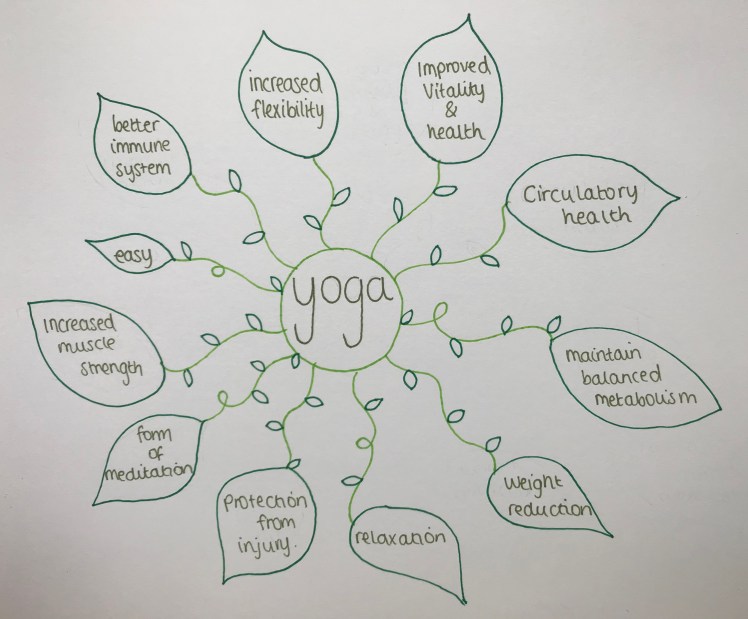
As you can see there are a lot of benefits from performing yoga, it would definitely be a smart idea to try to implement yoga into your routine, even if it’s just once or twice a week.
– I think that I should start performing more yoga, as it is an easy enough exercise, yet the list of benefits is so long. Especially if I take the time to go outside and perform some yoga in nature, I believe this would be a really good way to boost my happiness and energy levels.
Ergonomics:
Lastly, about physical health, I want to talk about ergonomics. Ergonomics is how humans relate to their surroundings in order to be comfortable. So many furniture pieces, especially office desks and chairs are poorly ergonomically designed, this leads to many negatives effects for our body: aches, pains, strains. Not only does poor ergonomics affect our body, but it can also affect our eyes, as we may be straining by squatting at a screen if it’s too far away, or if the words are too small, or if you’re not blinking often enough, or if the lighting in the room is poor. There are so many different aspects that you need to take into consideration if you want to have good physical health. Consider where you spend most of your time each day, is it sitting on a uncomfortable chair, or is it standing, slouching? If so then take time to reconsider where you spend most of your time, maybe it’s time to invest in a new, comfortable chair that is well ergonomically designed.
If you are unable to change the place where you sit or stand, be conscious of your health, and try to take regular small walks, even if it’s just around the office, or even on the spot. Prioritise your health and take time to evaluate your current situation in relation to ergonomics.
To conclude, if you are at a placement of work where you may be sitting for prolonged periods of time in an uncomfortable position, (for example: an office job), take time to perform some activities:
- Stretch- these can even be performed at your desk,
- Walk for a short period of time,
- Give your eyes a break,
- Take a break,
- Tell your manager about your concerns to see if they can help in any way.
Week Seven Evaluation – 16.03.20 – 20.03.20:
This week has been very strange, and we’ve all had to adapt how we’re living. Due to the coronavirus, our college has now been closed, which leads me to only be able to work from home. This has put a strain on everyone- as we have to learn to live through a different reality. Despite this closure, I have still been able to continue working on the health triangle from home. This week I spoke all about physical health. I’m glad that I was bale to complete this portion of the triangle within a week, as it gives me something to focus on, and I know what I need to achieve within that time frame. To keep my blog interesting I tried to include images and drawings, to give both a literal and physical perception of my work, this way it enhances learning for my readers.
I am going to try to stay motivated for FMP. It’s going to be challenging; as there are many distractions when working from home. However, I really want to do well on this project, so I am determined to carry on working at my best ability. Next week I am going to conclude working on the health triangle-by looking at psychological health, which is the corner I am most looking forward to researching.
Psychological Health:
Psychological health plays a large part in achieving optimum health, much like biochemical and physical health, they all tie in with eachother. When your psychological health is poor, it’s going to start affecting other aspects of your life too. So what is psychological health? Psychological health involves many different aspects, however it’s mainly to do with your mind, how you control your thoughts and emotions and how you handle different situations (eg: stressful, sad)- so your mental health.
Action Plan:


Research Log:


References:
adaa. (2018). /learn-from-us/from-the-experts/blog-posts/consumer/top-5-strategies-cultivating-your-mental-health.Available: https://adaa.org/learn-from-us/from-the-experts/blog-posts/consumer/top-5-strategies-cultivating-your-mental-health. Last accessed 21st February 2020.
alliedtravelcareers. (2018). /blog/how-good-posture-really-effects-you/.Available: https://www.alliedtravelcareers.com/blog/how-good-posture-really-effects-you/. Last accessed 18th March 2020.
better health. (2020). /health/conditionsandtreatments/posture. Available: https://www.betterhealth.vic.gov.au/health/conditionsandtreatments/posture. Last accessed 18th March 2020.
deardesignstudent. (2016). /how-to-pitch-a-project-4a391f7cf3b3.Available: https://deardesignstudent.com/how-to-pitch-a-project-4a391f7cf3b3. Last accessed 12th February 2020.
department. (2003). /cata/mcgaan/classes/cata339/audience-analysis101.htm. Available: https://department.monm.edu/cata/mcgaan/classes/cata339/audience-analysis101.htm. Last accessed 26th February 2020.
dreamstime. (2020). /photos-images/tree-white-background.html.Available: https://www.dreamstime.com/photos-images/tree-white-background.html. Last accessed 21st February 2020.
facebook. (2018). /lynseyholistichealth/. Available: https://www.facebook.com/lynseyholistichealth/. Last accessed 21st February 2020.
foreverconscious. (2018). /5-soul-groups-belong. Available: https://foreverconscious.com/5-soul-groups-belong. Last accessed 21st February 2020.
glow. (2020). /flickabright-pillar-candles.html. Available: https://www.glow.co.uk/flickabright-pillar-candles.html. Last accessed 21st February 2020.
Google. (2020). https://www.google.com/search?client=safari&rls=en&sxsrf=ACYBGNRY0Idj2ZN-HmxZFggDBgPzI8iBLA:1581075756956&q=Dictionary&stick=H4sIAAAAAAAAAONQesSoyi3w8sc9YSmZSWtOXmMU4-LzL0jNc8lMLsnMz0ssqrRiUWJKzeNZxMq. Available: https://www.google.com/search?client=safari&rls=en&sxsrf=ACYBGNRY0Idj2ZN-HmxZFggDBgPzI8iBLA:1581075756956&q=Dictionary&stick=H4sIAAAAAAAAAONQesSoyi3w8sc9YSmZSWtOXmMU4-LzL0jNc8lMLsnMz0ssqrRiUWJKzeNZxMq. Last accessed 7th February 2020.
headtohealth. (2020). /meaningful-life/physical-health. Available: https://headtohealth.gov.au/meaningful-life/physical-health. Last accessed 18th March 2020.
helpguide. (2019). /articles/stress/stress-symptoms-signs-and-causes.htm. Available: https://www.helpguide.org/articles/stress/stress-symptoms-signs-and-causes.htm. Last accessed 21st February 2020.
Henco. (2020). /en/page/environmentalpolicystatement/19665/.Available: http://www.henco.be/en/page/environmentalpolicystatement/19665/. Last accessed 21st February 2020.
medicinenet. (2020). /liraglutide_injection_saxenda/article.htm.Available: https://www.medicinenet.com/liraglutide_injection_saxenda/article.htm. Last accessed 18th March 2020.
mentalhealth. (2019). /blog/moving-self-destruct-self-care. Available: https://www.mentalhealth.org.uk/blog/moving-self-destruct-self-care. Last accessed 21st February 2020.
mindmup. (2019). /map/new/1581680433516. Available: https://app.mindmup.com/map/new/1581680433516. Last accessed 14th February 2020.
nathaliebond. (2020). /products/essential-oil-blends. Available: https://www.nathaliebond.com/products/essential-oil-blends. Last accessed 21st February 2020.
optinmonster. (2020). /emotional-intelligence-in-marketing/. Available: https://optinmonster.com/emotional-intelligence-in-marketing/. Last accessed 21st February 2020.
sports-centre. (2019). /young-peoples-self-organised-physical-activity-has-a-strong-social-aspect/. Available: http://sports-centre.org/young-peoples-self-organised-physical-activity-has-a-strong-social-aspect/. Last accessed 21st February 2020.
study. (2018). /academy/lesson/anaerobic-exercise-definition-benefits-examples.html. Available: https://study.com/academy/lesson/anaerobic-exercise-definition-benefits-examples.html. Last accessed 18th March 2020.
thestrive. (2019). /best-books-on-building-self-confidence/. Available: https://thestrive.co/best-books-on-building-self-confidence/. Last accessed 21st February 2020.
vox. (2020). /future-perfect/2020/1/10/21013234/meditation-brain-neuroscience-moral-obligation. Available: https://www.vox.com/future-perfect/2020/1/10/21013234/meditation-brain-neuroscience-moral-obligation. Last accessed 21st February 2020.
webmd. (2005). /healthy-aging/over-50-nutrition-17/poor-nutrition-signs. Available: https://www.webmd.com/healthy-aging/over-50-nutrition-17/poor-nutrition-signs. Last accessed 12th March 2020.
wittidesign. (2019). /products/rossi. Available: https://www.wittidesign.com/products/rossi. Last accessed 21st February 2020.
wordart. (2018). /create. Available: https://wordart.com/create. Last accessed 14th February 2020.
 Leanne Hooft's Blog