Project Brief:
I am working for The Mill. I am on the advertising team and I am asked to create an advertising concept for a customer of my choice, from their client list.
The Mill:
Everyone in The Mill community has a passion for their job. The Mill opened in 1990 and it was the most professional studio in Soho, London. 7 years later The Mill Film is launched which produced many famous films such as the first two Harry Potter movies, as they were becoming more successful it led to them opening ‘Mini Mill’s’ (in 2000) which then branched into small advertising agencies. In 2001 The Mill start to win awards for their ‘visual effects’ in ‘Gladiator’, they then start to get noticed more and more for their outstanding adverts and films. This leads them onto opening a platform to partner up to help other agencies and brands develop their work, this platform is called BEAM, it opened in 2002. As The Mill grow they start to open up different platforms and studios in countries such as LA, this broadens their horizons as they’re open to new locations and people. As the years go on The Mill start to win more awards such as a VES (visual effects society) award, this was for their paintings that appear in different adverts. 2009 was a big year for The Mill as they produced a really popular special effects app that really took off, in the same year they also won a BAFTA for one of their series. In addition, 1 year later The Mill, which is located in LA, won an EMMY and also an award for The Royal Television Society. Then on, from 2010 to 2018, The Mill continued to grow and they won more and more awards.
So in conclusion, The Mill are a really successful agency for adverts and tv series/movies, with multiple branches all over the world. They have won multiple awards which have made them very popular within the design industry. They have a huge team of people that have trained for years in their specific area, so when everyone is combined they are very strong with a wide range of skills to help produce the best outcome for their clients. Years of practice have led them to making some of the best and most viewed adverts up to now, they’ve teamed up with hundreds up companies, some including: BBC, Pepsi, Audi, Amazon, Google etc…
Facebook:
In 2004 one of the most famous networking sites was born, Facebook. It’s founder was Mark Zuckerberg, a very well known man in society. The sole purpose of Facebook is to connect you with friends and family, a way to stay connected so you do not lose touch. 2 years past and no one expected the amount of growth that would occur, anyone over the age of 13 could create an account, which opened the amount of people who could join. Facebook’s target audience is mainly adults but it is for anyone over the age of 13.
Advertising:
What is advertising? Advertising is a way to promote your brand/company/product to the community. It’s a way of spreading awareness of who you are and what your motive is. Advertising is present everywhere including newspapers, magazines, television, social media, clothes etc…
Audience:
When thinking about advertisements, it’s extremely important to think who you’e trying to reach out to the most. Audience relates to the group of people who you’re trying to create this product/company for. Normally your target audience will be a group of people who have an age range of around 5 years. So for example 8-13 year olds, 18-23 year olds ect…
Demographic groups:
This links to different classifications that you need to take into account in order to get the most suited target audience. Some of the most important demographics you would need to take into account would be gender, religion, age, ethnicity, location, income ect.. Different people fall into different demographic groups, so you need to analyse each of these groups then produce your target audience from there.
Motion Graphics:
Motion Graphics involves small animated illustrations and movement within text. The main purpose of motion graphics is to tell a story, many advertising agencies use motion graphics within their adverts because they’re a great way to get your point of view across.
Ethics:
Ethics link to your moral principles, and the values that you hold. This is important within advertising because your advert cannot promote unhealthy or rude behaviour.
Laws in Advertising:
When creating adverts it is very important that you take into considerations genders, races, religions and ages so you do not offend anyone. You need to base your advert upon facts, you cannot falsely sell an item.
Analysing an Advert:
I decided to view one of Facebook’s previous adverts and analyse it to help me understand Facebook and advertising in general.
Advert I’m analysing – https://youtu.be/SSzoDPptYNA
Narrative Structure:
- What is the story of the advert?
Facebook’s main goal is to connect people. This is shown throughout this advert as they’re comparing people to chairs. The advert talks about how chairs are for people to use to take a break, or you can sit on chairs within a group, so you can share stories and communicate with each-other.
- Who is the story supposed to attract?
The story is aimed to connect with people who may be feeling lonely, it’s reaching out to those who may need a bit of affection and attention. It will attract people who want to start new friendships, or to rekindle lost ones.
- How will the story affect the viewer’s emotions?
The story is quite abstract- you do not normally connote chairs with people, so the story is aimed to hopefully make people pause and think how and what they could do to connect with one another.
Dialogue:
- How is language used?
Throughout the advert repetition is used, the word ‘alone’ is repeated many of times, this is to emphasis the main goal of Facebook, and that would be to connect people so that they don’t feel ‘alone’.
- What mood does the language create?
The advert has quite a sombre tone, the way the voice-over is spoken is very soft, there are not any loud shouts or screams, this makes the advert seems more delicate and that you really need to listen in to what the narrator is saying.
Colour, Music:
- How does music grab the attention?
The music starts of very quiet, in the first scene the chair is in the woods, so the music is very quiet and delicate, the music gradually gets louder and louder as the advert progresses. This intrigues people as they can tell the music is building up to something.
- Is there a jingle? Good or bad?
There isn’t a jingle, this is because they don’t need one to allow you to remember Facebook, every time you look at a chair after watching this advert you will think of Facebook; so a jingle is not necessary.
- What effect does colour have?
The advert finishes really dark, it lastly talks about space, by putting the darkest scenes at the end it leaves you with a clear canvas to reflect and think upon what the advert taught you.
Purpose:
- What is the purpose of the ad? Not always is it to sell, think about government ads for example.
The main purpose of this advert is for people to stop and think about what they can do to connect with other people so they feel better within themselves.
- Is the ad successful at it’s purpose?
I think the advert is successful in fulfilling it’s goal. As a person watching this advert it does make me stop and re-evaluate what I can do in order to stay in contact with important people in my life.
Meaning:
- Is there a hidden meaning in the ad?
I don’t believe there are any hidden meanings throughout this advert, I think it’s very pure and innocent which makes people want to use the app even more.
- Is there any symbolism?
Certain words are written out on the screen, for example: ‘doorbells, bridges, aeroplanes’. These are written out on the screen because they all symbolise connectivity. Doorbells allow you to show someone your presence, bridges allow you to cross difficult paths with ease, and aeroplanes allow you to get from one place to another. They are all symbolic meanings of connecting.
- What has been left out of the ad?
The negatives of Facebook, and what could happen if you miss-use Facebook.
- Could it be misrepresenting the truth?
The only thing with this advert is that it only shows you the best side of Facebook, it doesn’t show you that people are able to leave nasty comments on your posts, or harass you in messenger.
Target Audience:
- Who are they/What is their demographic?
Their demographic is very large, anyone above the age of 13 can use Facebook- so there are not really any limitations on who can use the app.
- How might people different from you, view the ad?
Some people might get slightly confused as people, in reality, are nothing like chairs, so people might not see the symbolic meaning of the chair and they might take it literally. This means that the message of ‘connecting people’ wont be clearly given to those viewers.
Initial Ideas:
Developed Ideas/Story Boards:

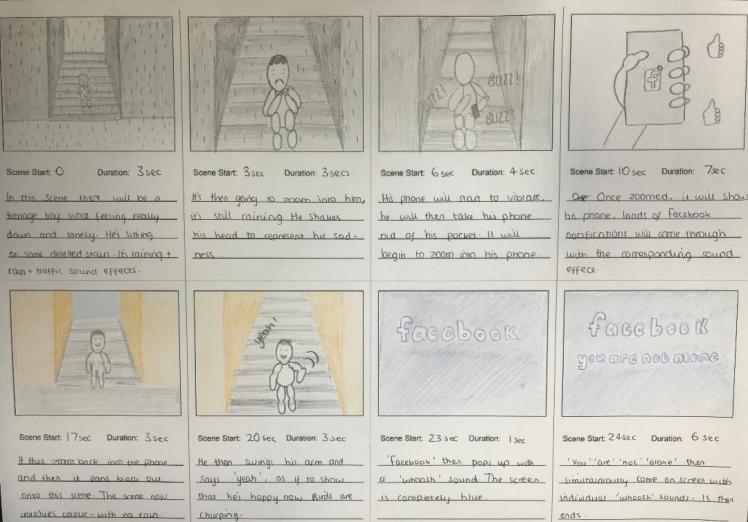
My story boards consists of 8 scenes, I drew what would be visible in each of these scenes, I also wrote when the scene started and the duration of the scene. I also wrote a small explanation of what is going on in the scene and any sounds effects that would also be in the scene.
Final Advert:
Evaluation:
Throughout my research on this unit I only ever used secondary research sources such as the internet. There are ways I could’ve incorporated primary research into my work, such as producing a questionnaire on Facebook and handing it out to different people in order to get their views and opinions upon the subject. however, due to my time limitations I thought it would be quicker for me to use sources like Google. I did still use reliable websites, they’re reliable because the facts came from the companies themselves, and the websites were also very up-to-date so all the statistics were still relevant.
On this unit there wasn’t much research that needed to be done compared to other units in the past, hence why I used secondary research sources. I also used YouTube in my research, this was when viewing other previous adverts. I was yet to use videos as a means of research so now I have expanded my boundaries and branched out to watching videos on the subject. Prior to this unit, I had very little knowledge upon adverts and advertising, so by researching and analysing existing adverts I have learnt a lot, such as what slight changes can make an advert going from bad to really good. These slight changes being light, language, colours etc… This influenced my design work because it allowed me to involve these key aspects in my work.
Next time I will ensure to try to incorporate primary research in order to make my work more reliable and so I can get different opinions on the subject which may in turn influence and inspire my final creation.
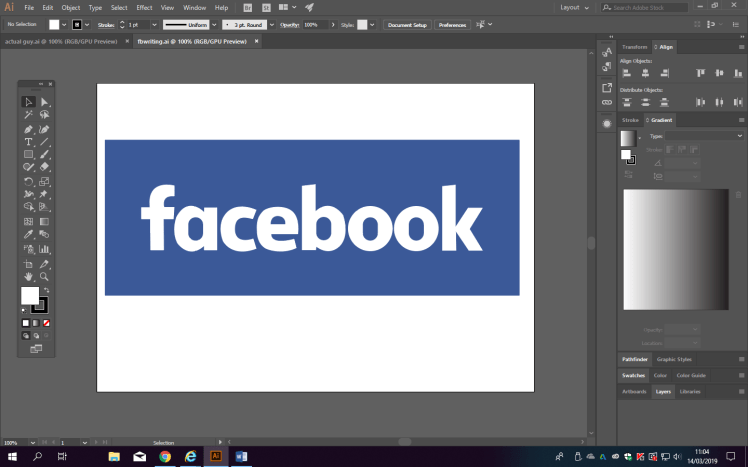
Within my advert I decided to keep the typeface the same as Facebook’s original. This was because I didn’t want to confuse anyone, in addition, it will also be clearer on what I’m trying to advertise because people will recognise the font. This means that the typeface I chose is legible as it is already a very famous typeface. The font I chose is very fit for purpose because, as I’ve previously stated, it it the same typeface as Facebook’s current logo. My advert only includes a handful of words, this made it easy for me to ensure I didn’t have any spelling mistakes throughout my work. Next time I could branch out and experiment with different typefaces just to give a variety of different approaches and ideas.
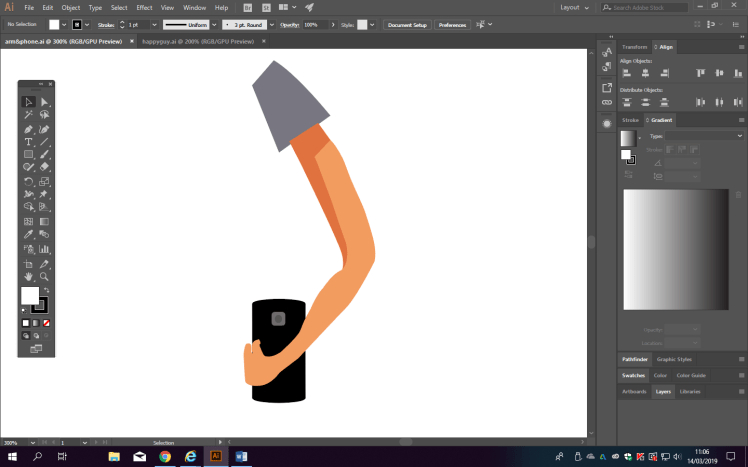
In my opinion, the designs I imported are laid out well, I ensured all the images were large so they were legible and so you could easily see the drawings. My annotations are also clear and you can see my thought process throughout each design as I imported them in the order of which I produced them, this way it’s as if I’m taking you on a journey with me.
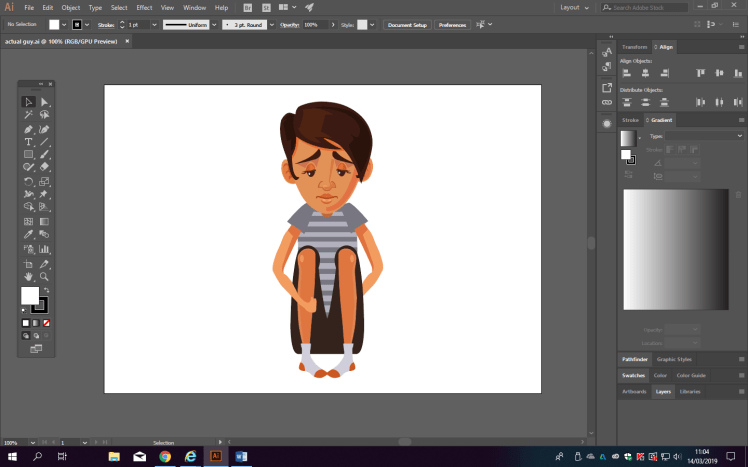
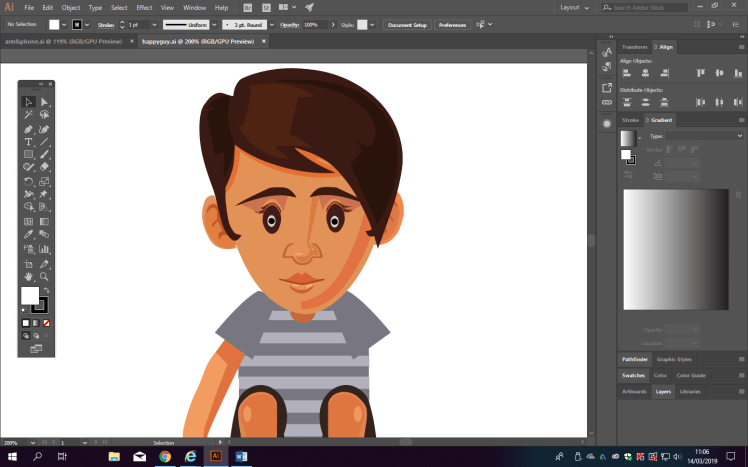
Some viewers such as teenagers and unstable adults may find my advert quite distressing, this is because it involves a young adult who is depressed and he does look very upset and lonely. However, I still think my advert is fit for my audience because it shows you reality, it conveys what can and does happen in the real world. Although it might be quite graphic, I do not believe it is too inappropriate to show. My advert conveys my ideas accordingly, I wanted to show that Facebook can and does help people feel as if they’re a part of something bigger, it makes them feel included and as if they have people they can rely upon.
I took into consideration ages, races, religions and genders. I thought that because Facebook is aimed for people above the age of 13, the viewers are mature enough to understand different emotions and how there are people out there to help, even if they are on a computer screen. My advert is suitable for all religions as it’s just showing an animated reality, there’s nothing that could possible offend anyone.
My work meets the brief because I did create a 30 second long advert, the brief gave me a variety of medias I could produce the advert on, I made my advert on Adobe After Effects, which was one of the options from the list provided. The language I used throughout my advert, I believe, is very appropriate, ‘You Are Not Alone.’. I decided to choose this message because I feel as if it conveys what Facebook is trying to send out and accomplish. The phrase is very straight forward and it cannot be misinterpreted in any way, making it appropriate as people of all ages and religions will be able to understand what I am saying.
In all honesty, this blog post compared to my previous posts, I believe, isn’t as professional-looking as it can be. This is because on the questions when analysing an advert, the questions are bullet pointed, in my opinion, this looks quite messy as it doesn’t give your eyes a clean sheet to read- your eyes need to keep jolting back and forth as the bullet points mess up the linear appearance. Next time I wont use bullet points within my blog posts as I am not happy with how it looks overall.
I decided to produce my work on Adobe After Effects because I wanted to learn a new media, I want to gain as much knowledge on different websites as possible. I chose to animate my advert over using cameras and green-screens because I’ve already had experience with these in the past, I thought it would be best for me to try something completely new instead of playing it safe and using something I have knowledge on already. My experience with Adobe After Effects is overall good, I enjoyed working with that media, I thought it was relatively straight forward and the aspects like timeframes and rotations were easy to grasp.
Along the journey of creating my advert I did have a few mishaps. At one stage my advert didn’t fill the screen, I didn’t realise this until I was ready to render my video. So, I had to go back and edit my whole video, this meant changing the scale of each individual frame, and re-lining up each section of my scenes. It was quite time consuming so going into the future I will always double check that my video actually fills up the screen. I have mixed opinions upon my final advert. Overall I am happy with how it turned out, however there are definitely areas I could improve upon, but I’m taking into consideration that this is my first time using this media and creating an advert, I’m also considering the little amount of time we had. We only had a short amount of time for this project because if we were given any longer we will begin to run into our next project which is a lot more important that this unit. So I’m prioritising my next unit over this one.
I am happy because I have produced a sufficient advert. There are areas within the advert that I’m not over-ly keen on, like when he says ‘yeah!’, but I feel like it gives the advert more of a comical spin, juxtaposing the beginning of the advert, evoking multiple emotions to the audience.
This unit is different to my previous units because I was only aiming for a pass, whereas in my other previous units I was aiming for merits/distinctions. I was only aiming for a pass because, again, the amount of time we had limited the amount of work I could produce. Another reason I was only aiming for a pass is because we had two other units that were due at the same time as this unit (units 3 & 4), so I had a lot of work that I needed to do. However, now all these units are complete I have a clear mind and a positive attitude for my final major project that is starting shortly.
References:
biteable. (2019). /blog/inspiration/what-is-motion-graphics/. Available: https://biteable.com/blog/inspiration/what-is-motion-graphics/. Last accessed 27th Feb 2019
indiatimes. (2019). /definition/advertising. Available: https://economictimes.indiatimes.com/definition/advertising. Last accessed 27th Feb 2019.
marketingartfully. (2019). /2010/11/10/what-are-important-customer-demographics/. Available: https://marketingartfully.com/2010/11/10/what-are-important-customer-demographics/. Last accessed 27th Feb 2019.
themill. (2019). /home. Available: http://www.themill.com/home. Last accessed 20th Feb 2019.
youtube. (2014). /watch?v=SSzoDPptYNA. Available: https://www.youtube.com/watch?v=SSzoDPptYNA. Last accessed 3rd March 2019.
 Leanne Hooft's Blog